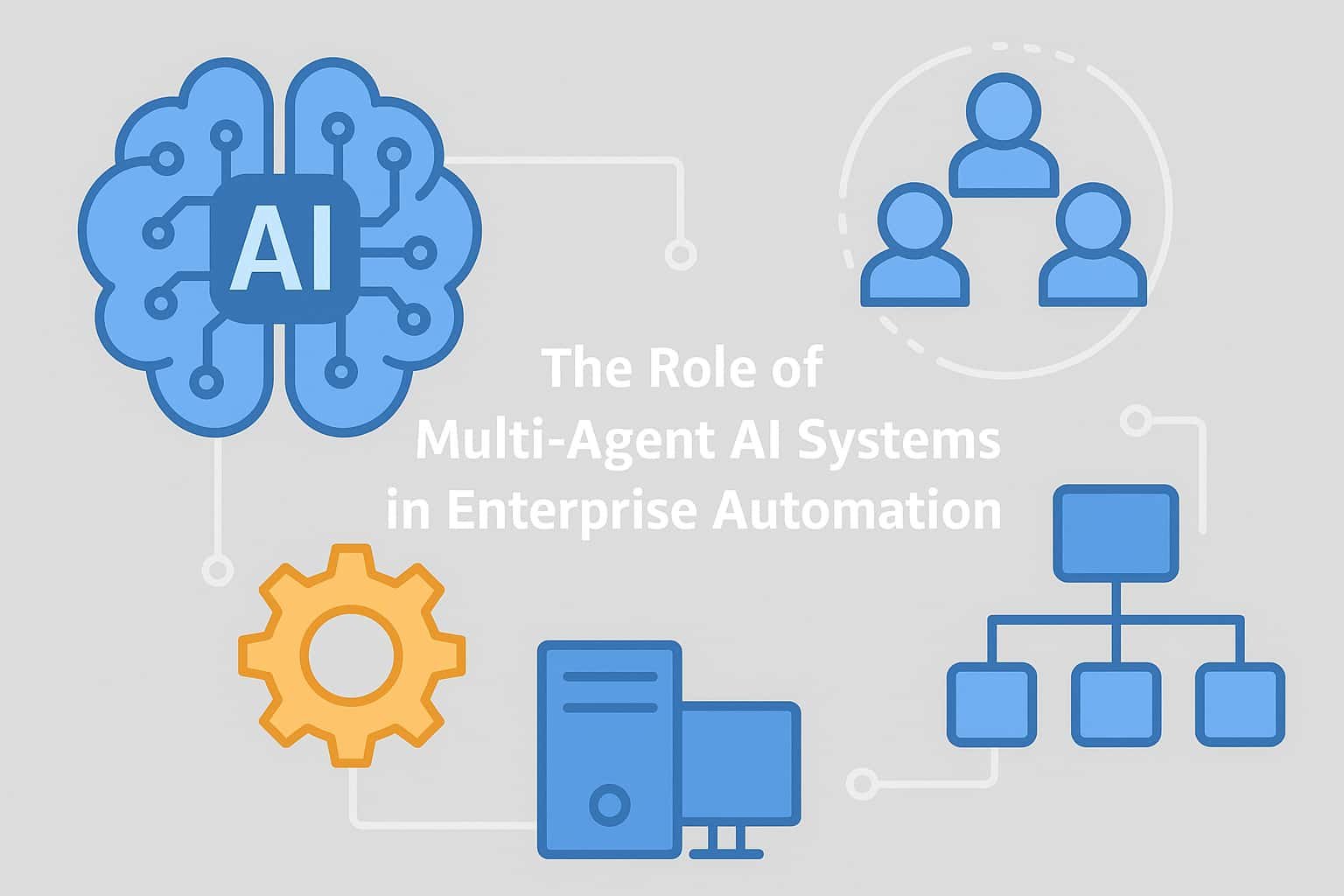
Enterprise automation is moving beyond single-purpose AI tools and rule-based process engines. As organizations scale their technology ecosystems, they face increasingly interconnected workflows across departments, data sources, infrastructure layers, and digital channels. A traditional AI solution built around a single model or isolated inference logic can no longer orchestrate such complexity. The emerging solution is multi-agent architecture — a network of AI-driven components that collaborate, negotiate, and coordinate actions like a digital workforce.
Multi-agent AI goes far beyond simply running several models in parallel. It introduces roles, autonomy, communication protocols, and dynamic decision layers. Each agent specializes in a function — data acquisition, risk analysis, forecasting, validation, optimization — and then works with other agents to deliver outcomes. This model resembles human organizations: specialists working as a coordinated team rather than a single monolith. When deployed at scale, multi-agent ecosystems can plan workflows, resolve conflicts, learn from feedback loops, and continuously adapt to changing conditions without human micro-management.
This approach is rapidly becoming foundational for next-generation enterprise automation, especially in industries with high process density like banking, logistics, manufacturing, telecom, ecommerce, insurance, and healthcare. Instead of building tools that “help operators do tasks,” enterprises are beginning to build AI collaborators that interact with systems, resources, and even other software agents.
From Single Intelligence to Collaborative Reasoning
The evolution from standalone AI to multi-agent orchestration reflects a shift in expectations. Early corporate AI initiatives focused on classification, forecasting, anomaly detection, or simple natural language processing. These tasks are useful, but narrow. Multi-agent AI systems introduce reasoning about goals, constraints, trade-offs, and situational feedback.
In practice, a distributed network of cooperating agents allows:
- Division of cognitive labor — specialized models can perform deep tasks quickly instead of relying on a one-size-fits-all pipeline.
- Emergent intelligence — multiple agents surface insights that no isolated model could produce.
- Improved fault tolerance — if a component fails or produces weak output, other agents can correct, flag, or override it.
- Adaptive orchestration — workflows can reorganize automatically when context changes.
Enterprises operating complex supply chains, distributed infrastructure, or customer-service ecosystems quickly see the benefits. Instead of humans stitching together disconnected outputs from different AI tools, the multi-agent layer coordinates them as a system-of-systems.
One of the reasons this approach is gaining traction is that it mirrors how strategic business decisions are made: not by a single optimizer, but through a network of competencies. This is the same philosophical idea captured by Herbert A. Simon in his observation that “Nothing is more fundamental in setting our research agenda and informing our research methods than our view of the nature of human beings” — implying that effective intelligence is inherently distributed across roles and reasoning contexts.
Core Components of Enterprise-Grade Multi-Agent Architecture
To apply multi-agent AI effectively, the underlying architecture must support coordination, autonomy, and shared context. Most deployments follow at least four foundational building blocks:
1. Agent Roles and Capabilities
Agents must have identity, scope, specialization, and constraints. A forecasting agent should not also route tickets or deploy cloud resources. Specialization creates reliability and transparency. In large enterprises, dozens of micro-agents may be deployed — some analytic, some generative, some operational.
2. Communication and Negotiation Protocols
Agents need structured ways to exchange knowledge and delegate tasks. This typically involves message buses, shared vector memory stores, orchestration layers, or event-driven triggers. Negotiation logic allows agents to weigh priorities, resolve conflicts, and escalate if context shifts.
3. Shared State and Context Awareness
Enterprise automation requires more than inference — it requires understanding what is happening across the system. Multi-agent frameworks maintain shared memory or knowledge graphs that agents can reference. This prevents duplicated effort and enables staged reasoning.
4. Safety, Compliance, and Governance
Agents with autonomy must remain auditable. Governance rules define boundaries: when to defer to a human, what risk thresholds apply, which policies must be upheld. This is where modern engineering integrates responsible machine learning safeguards as a design principle rather than a defensive add-on.
When these four pillars are executed well, multi-agent orchestration can act like a digital operating layer for enterprise decision-making — coordinating logistics, finance, operations, service delivery, and optimization cycles through continual iteration.
Real-World Applications, Benefits, and Strategic Impact
Business-Oriented Use Cases
Multi-agent AI is now surfacing in a variety of enterprise workflows such as:
- Autonomous customer support ecosystems where different agents handle intent classification, policy validation, resolution generation, and satisfaction forecasting.
- Supply chain orchestration where agents negotiate transport windows, inventory constraints, and risk signals from external data feeds.
- Security automation where some agents detect anomalies, others triage incidents, and others resolve configuration drift.
- Financial operations where compliance, fraud detection, forecasting, and liquidity allocation run in coordinated micro-pipelines.
These interactions create compound value. Instead of siloed automation, the enterprise gets synergy — the intelligence of the network exceeds the sum of its parts.
Business Advantages
When structured correctly, multi-agent orchestration creates three immediate benefits:
- Operational scalability — Traditional tools scale linearly. Multi-agent systems scale through coordination, not expansion of a single brain.
- Faster learning cycles — Each agent refines its own skill set without slowing others.
- Contextual trust — Because logic is modular, audits become clearer: enterprises can trace which agent made which decision and why.
From a leadership perspective, the shift to multi-agent automation is less about replacing workers and more about institutionalizing resilience: distributing cognition so that no single model, workflow, or department becomes a bottleneck.
Implementation Challenges and the Role of Governance
Even though the technical promise is strong, real-world adoption requires careful organizational design and governance. The biggest challenges are not raw model accuracy, but:
- Unclear boundaries of autonomy — If too many agents operate without guardrails, emergent behavior can become noise.
- Integration with legacy architecture — Older systems were not built for composable intelligence.
- Auditability and policy enforcement — Enterprises must know which agent triggered which outcome.
- Cultural readiness — Teams must treat agents as collaborators rather than tools.
This is where maturity frameworks help: starting with single-task agents, evolving to cooperative reasoning, then layering strategic autonomy. The most successful implementations structure multi-agent rollouts like a staged transformation program rather than a technical experiment.
A second governance dimension involves the AI System layer that sits between agents and enterprise data. It is essential that this substrate enforces policies, lineage tracking, and knowledge provenance. Without this layer, agent autonomy risks drifting into opacity.
Future Outlook: Multi-Agent Ecosystems as Digital Institutions
As multi-agent systems accelerate, organizations will evolve from “AI-enabled” to “AI-mediated.” Certain business functions may be overseen by supervisory agents coordinating operational ones. We can also expect:
- Role-based agent marketplaces inside enterprises
- Dynamic delegation where a higher-order agent recruits specialists on demand
- Self-evolving pipelines that tune architecture automatically
- Context-aware workflow rewiring during stress or change
In the same way that cloud computing became the default substrate for modern applications, multi-agent cognition is likely to become the substrate for enterprise automation.
Conclusion
Multi-agent AI systems are transforming how enterprises coordinate intelligence, design operating models, and scale decision-making. By combining role specialization, shared context, agent negotiation, and layered governance, organizations move beyond old automation models into a new age of autonomous, adaptive collaboration.
Multi-agent architecture does not merely speed processes — it reshapes how enterprises think, reason, and respond. In the decade ahead, it may define the competitive frontier for digitally mature organizations.