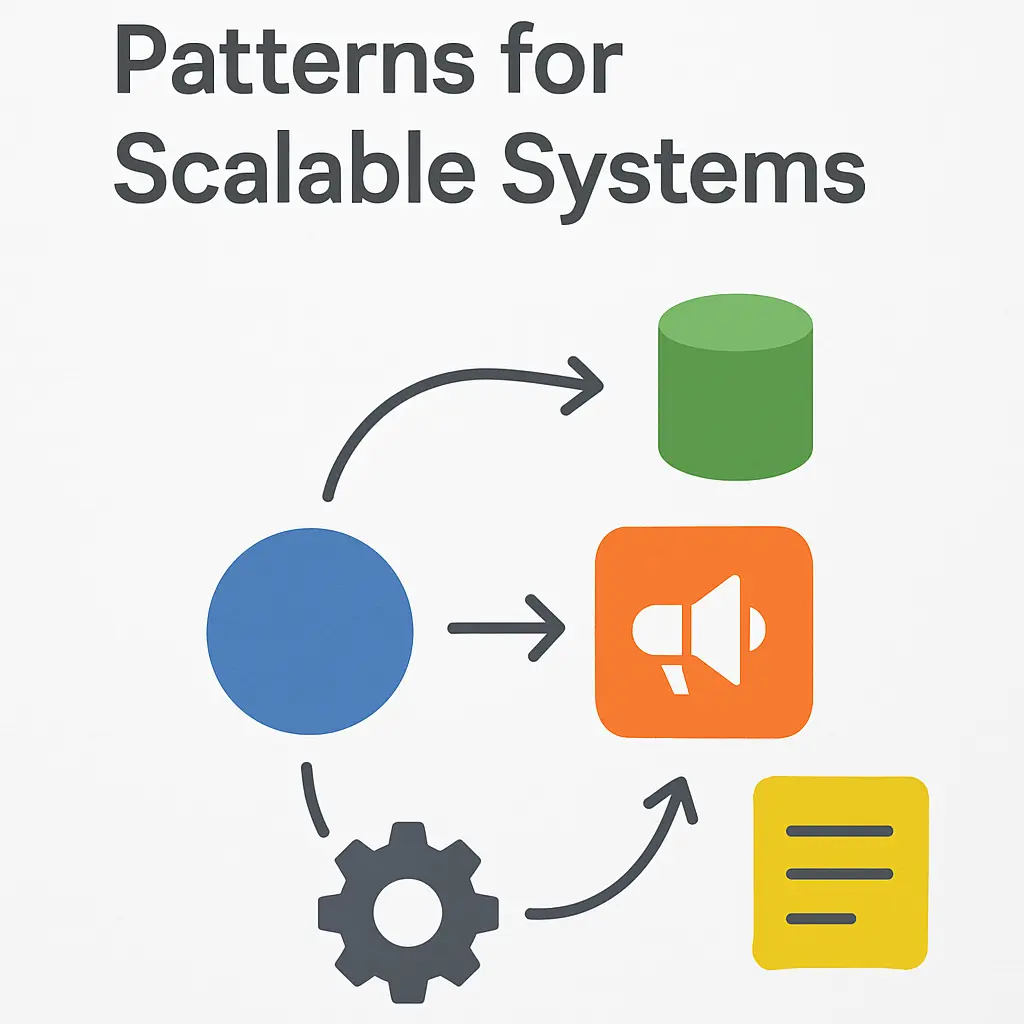
Event-driven architecture has become a cornerstone of modern software design because it helps organizations build systems that react quickly, scale efficiently, and integrate cleanly across services. This article explores how event-driven architecture patterns work, why they matter in distributed environments, and which implementation choices influence reliability, scalability, and business agility in real-world systems.
Understanding Event-Driven Architecture and Why It Scales
Event-driven architecture, often shortened to EDA, is an approach in which software components communicate by producing, routing, and consuming events. An event represents something that has already happened: an order was placed, a payment was approved, a shipment was dispatched, or a sensor reported a temperature change. Instead of forcing one system to call another directly and wait for a response, EDA allows producers to emit information and consumers to react when appropriate. This seemingly simple shift has deep consequences for scalability, fault isolation, speed of development, and operational resilience.
At the center of event-driven thinking is decoupling. In tightly coupled systems, one application frequently depends on the availability, interface, and performance of another. If a downstream service slows down or becomes unavailable, the caller is often affected immediately. In contrast, event-driven systems separate the producer of a fact from the consumer of that fact. The producer does not always need to know who listens, when they listen, or how many listeners exist. This makes it easier to evolve services independently and to add new business capabilities without redesigning an entire platform.
Scalability emerges naturally from this model because work can be distributed over time and across multiple consumers. In a synchronous request-response architecture, a user action may trigger a chain of blocking calls, each consuming resources while waiting for the next service. In an event-driven model, messages can be queued, partitioned, and processed in parallel. This lets teams absorb spikes in traffic without collapsing under temporary overload. It also enables selective scaling, where only the services handling a heavy event stream need more resources, instead of scaling an entire monolithic application.
Several foundational patterns make event-driven systems practical:
- Event notification: A service emits an event to inform other systems that something happened, but the event contains minimal data. Consumers may fetch additional details if needed.
- Event-carried state transfer: The event includes enough data for consumers to act without making another request, reducing dependency on direct service calls.
- Request-reply over messaging: While less loosely coupled than pure eventing, this pattern uses asynchronous transport to improve reliability and buffering.
- Competing consumers: Multiple workers read from the same queue or stream partition, allowing high-throughput processing and horizontal scaling.
- Publish-subscribe: One event can be consumed by many services, enabling extensibility and domain-driven growth.
These patterns do not exist in isolation. They reflect different answers to key architectural questions: Should consumers fetch additional state or receive it directly? Should ordering be preserved? How much delivery delay is acceptable? Should the event represent a business fact or a technical trigger? The answers depend on domain needs, compliance constraints, and expected scale.
One of the most important distinctions in EDA is the difference between events, commands, and queries. An event states that something happened in the past and is not asking for permission. A command tells a specific service to do something. A query asks for data. Mixing these concepts leads to confusion and fragile integrations. Teams that model everything as “messages” without semantic discipline often create systems that are hard to reason about. Clear boundaries are essential because event-driven systems can become sprawling if every service reacts to every signal without governance.
Architecture style alone does not guarantee success. Event-driven systems introduce trade-offs, especially around consistency and observability. In a distributed platform, data may not become consistent everywhere instantly. This is known as eventual consistency. It is often acceptable, but only when product teams understand where delay is tolerable and where stronger guarantees are required. For example, a recommendation engine can tolerate some lag, while fraud detection or payment reconciliation may require tighter controls. Designing for scalability therefore means designing explicitly for consistency expectations, user experience, and failure handling.
Another key concept is the distinction between event brokers and event streams. Traditional message brokers often focus on routing, delivery guarantees, and work distribution. Event streaming platforms add durable logs, replay capabilities, and consumer-managed offsets. This difference matters because scalability is not just about sending messages fast; it is also about recovering from failures, reprocessing historical data, auditing decisions, and supporting analytics. Systems that need long-term event history often benefit from stream-oriented infrastructure, while task-based workflows may fit queue semantics better.
The business value of EDA is strongest when events are aligned with real domain concepts. Instead of technical messages like “database row updated,” strong architectures favor business-relevant events such as “invoice issued” or “subscription canceled.” Business events are more stable, more meaningful to downstream teams, and more reusable across products. They also help organizations move toward domain ownership, where teams publish data about what happened in their bounded context and others consume it without violating service autonomy.
When teams want a more detailed introduction to practical design choices, common messaging models, and scalable implementation structures, resources such as Event Driven Architecture Patterns for Scalable Systems can help frame the broader landscape before moving into operational specifics.
Core Patterns, Delivery Guarantees, and Data Consistency in Real Systems
Once the fundamentals are clear, the next step is understanding how event-driven systems behave under real production conditions. The most difficult challenges are not about sending events but about ensuring those events are trustworthy, usable, and resilient under failure. This is where deeper architectural patterns matter.
A common pattern in scalable systems is publish-subscribe. In this model, a producer emits an event to a topic, and multiple consumers subscribe independently. This is ideal when one business action triggers several downstream processes. An order placement, for instance, may update inventory, notify analytics, initiate shipping, and trigger loyalty calculations. The producer remains unaware of these consumers, which means new capabilities can be added with minimal disruption. This extensibility is a major reason organizations adopt event-driven architectures as their digital ecosystems grow.
However, publish-subscribe can create hidden complexity if event contracts are poorly designed. Consumers may become dependent on fields that were never meant to be stable. Over time, producers hesitate to evolve their schema because too many unknown services might break. To avoid this, teams should treat events as versioned contracts. Good event contracts are:
- Explicit: The event name clearly reflects a business fact.
- Stable: Fields are added carefully, and breaking changes are minimized.
- Documented: Ownership, semantics, and delivery expectations are clear.
- Governed: Schemas are validated and lifecycle-managed.
Another major pattern is event-carried state transfer. Instead of notifying consumers and forcing them to call back for data, the producer includes relevant state in the event itself. This reduces chatty service interactions and helps systems remain decoupled under high load. It is particularly useful when many consumers need similar information. Still, there is a balance to maintain: oversized events increase network overhead, duplicate data widely, and can expose fields that should remain private. Effective design requires understanding what data is necessary for autonomous consumption and what should remain within the originating domain.
For workflows spanning multiple services, architects often use the saga pattern. A saga coordinates a sequence of local transactions connected by events rather than relying on a single distributed transaction. If one step fails, compensating actions can undo prior work or drive the process toward a safe business outcome. Consider a travel booking flow involving flights, hotels, and payments. A single atomic transaction across all providers is unrealistic. A saga allows each service to manage its own data while reacting to success or failure events. This supports scalability because each component remains independently deployable and locally consistent.
There are two broad saga styles:
- Choreography: Services react to events without a central coordinator. This is flexible and decentralized but may become hard to trace as logic spreads across services.
- Orchestration: A dedicated component directs the workflow and emits commands or events. This improves visibility and process control but introduces another service to manage.
Choosing between these styles depends on the complexity of the business process, the need for centralized monitoring, and the team’s ability to govern distributed behavior. Choreography fits simple domain reactions; orchestration often fits regulated or mission-critical flows where auditability matters.
Delivery guarantees are another area that demands careful thinking. Terms like at-most-once, at-least-once, and exactly-once are often used casually, but they have practical consequences. At-most-once avoids duplicates but risks message loss. At-least-once ensures messages are delivered, but duplicates may occur. Exactly-once is often expensive, context-dependent, and sometimes misunderstood because it may rely on guarantees that hold only within limited system boundaries. For many business systems, the realistic solution is not magical exactly-once processing but idempotent consumers. A consumer is idempotent if processing the same event multiple times produces the same final result. This is a crucial design principle in scalable event-driven environments.
Idempotency can be achieved through techniques such as:
- Event IDs and deduplication stores
- Upserts instead of blind inserts
- State transition guards
- Business keys that prevent duplicate effects
Without idempotency, retries become dangerous. Yet retries are unavoidable in distributed systems because failures are normal: networks timeout, consumers restart, brokers rebalance, and downstream dependencies become unavailable. Scalable design does not assume smooth operation; it assumes recoverable disruption.
Consistency is equally important. In event-driven systems, one service often owns the source of truth, while other services maintain derived views optimized for their own needs. This pattern improves autonomy and performance, but it creates synchronization challenges. To address them, many teams use the transactional outbox pattern. Here, a service writes both its local business data and a pending event record within the same database transaction. A separate process then publishes the outbox record to the broker. This avoids a dangerous scenario in which the database update succeeds but the event publish fails, or vice versa. The outbox pattern is one of the most practical tools for preserving consistency between internal state changes and external event publication.
A related approach is change data capture, or CDC, which monitors database changes and turns them into event streams. CDC can be effective for integration and migration use cases, especially when legacy systems cannot be modified easily. But architects should be careful not to confuse low-level data changes with well-modeled domain events. CDC is powerful infrastructure, not a substitute for business semantics.
Event sourcing is another advanced pattern worth examining. In event sourcing, state is not stored as only the latest value. Instead, every state-changing event is recorded as the source of truth, and current state is reconstructed by replaying events. This can provide excellent auditability, temporal analysis, and replay-based recovery. It also fits domains where the sequence of changes is more valuable than the latest snapshot alone, such as finance, logistics, and compliance-heavy workflows. Yet event sourcing adds complexity in schema evolution, replay cost, debugging, and projection management. It is not necessary for every event-driven system and should be adopted only when its benefits clearly outweigh its operational burden.
Operating Event-Driven Systems: Observability, Governance, and Long-Term Evolution
After architectural patterns and consistency models are in place, long-term success depends on operations and governance. Many event-driven initiatives fail not because the basic concept is wrong, but because teams underestimate how difficult distributed visibility, ownership, and change management can become at scale.
Observability is the first operational pillar. In a synchronous system, tracing a user request may be relatively straightforward. In an event-driven system, one action can trigger many asynchronous reactions across multiple services over an extended time window. To understand behavior, teams need strong telemetry that includes correlation IDs, event metadata, structured logs, distributed traces where possible, and metrics for lag, throughput, retry volume, dead-letter rates, and consumer health. Without these, failures become mysterious and trust in the architecture erodes.
Dead-letter queues or dead-letter topics play a major role in fault handling. When a consumer cannot process a message after repeated attempts, the event should usually be isolated rather than blocking the entire pipeline. But a dead-letter mechanism is not a solution by itself. Teams need processes for triage, replay, root cause analysis, and correction. A dead-letter queue that nobody monitors simply becomes a graveyard of business failures. Mature operations require clear ownership and response workflows.
Backpressure is another crucial concern. If producers emit events faster than consumers can process them, lag accumulates. Sometimes this is acceptable, but in time-sensitive domains it can create serious business issues. Strategies for handling backpressure include:
- Horizontal scaling of consumers
- Partitioning event streams for parallelism
- Rate limiting or throttling producers
- Prioritizing critical event categories
- Using buffering and load-shedding policies where appropriate
Partitioning deserves special attention because it directly affects scalability and ordering. If all events are sent through a single partition, ordering is easy but throughput is limited. If events are spread across many partitions, throughput improves but global ordering disappears. Most large-scale systems therefore aim for key-based ordering, preserving sequence only for related entities such as a customer account or order ID. This compromise usually aligns well with business behavior while enabling practical horizontal scale.
Security and compliance must also be designed into event-driven platforms. Events often travel farther and persist longer than synchronous API payloads. This means architects must control access to topics, encrypt data in transit and at rest, classify sensitive payload fields, define retention policies, and ensure personally identifiable information is handled properly. A scalable system that leaks sensitive data or violates regulatory obligations is not truly successful. Event minimization, payload masking, and policy-based topic governance help reduce this risk.
As organizations expand, event governance becomes increasingly important. Governance is not about bureaucracy for its own sake. It is about preserving clarity in a growing network of producers, consumers, schemas, and domain boundaries. Good governance includes:
- Named ownership for every event type and topic
- Schema registries and compatibility checks
- Documentation for semantics, retention, and consumer expectations
- Review processes for introducing new events and deprecating old ones
- Catalogs that help teams discover existing event streams before creating redundant ones
This operational maturity supports long-term evolution. One of the promises of event-driven architecture is that systems can change without massive coordinated releases. But that promise holds only if changes are backward compatible and teams can reason about downstream impact. Versioning strategy is central here. Instead of deleting fields or changing meanings abruptly, teams should add new fields, publish new event versions carefully, and deprecate old structures over time. Semantic stability matters more than technical convenience.
There is also a strategic dimension to EDA. Event-driven systems are not merely technical patterns; they shape how organizations think about business processes. Events create a timeline of facts that can feed analytics, automation, machine learning pipelines, and customer experience improvements. When modeled well, they become a shared language between operational systems and data platforms. This is one reason the architecture has grown in importance: it supports not only scalable transaction processing but also real-time business insight.
Still, EDA is not a universal answer. Some interactions are better handled synchronously. If a user needs an immediate validation result, a direct API call may be the right tool. If a process is simple and local, introducing brokers, retries, schemas, and asynchronous monitoring may add unnecessary complexity. The strongest architectures are pragmatic hybrids. They use synchronous communication where immediacy and simplicity matter, and asynchronous eventing where decoupling, resilience, and scale provide real value.
For teams refining this balance and comparing implementation options across broker models, consistency strategies, and service boundaries, Event Driven Architecture Patterns for Scalable Systems offers another useful perspective on how scalable event-centric systems are structured in practice.
In the end, event-driven architecture succeeds when it is treated as both a technical and organizational discipline. It requires thoughtful event modeling, clear contracts, resilient delivery patterns, observability, governance, and a realistic understanding of consistency trade-offs. When these elements align, EDA becomes far more than a messaging technique: it becomes a powerful foundation for scalable, adaptive, and durable software systems.
Event-driven architecture enables scalable, resilient systems by decoupling services, distributing workload efficiently, and supporting flexible business evolution. Its success, however, depends on disciplined event design, consistency strategies, idempotent processing, observability, and governance. For readers planning modern distributed platforms, the best conclusion is practical: adopt event-driven patterns deliberately, where they solve real complexity and create lasting operational advantage.