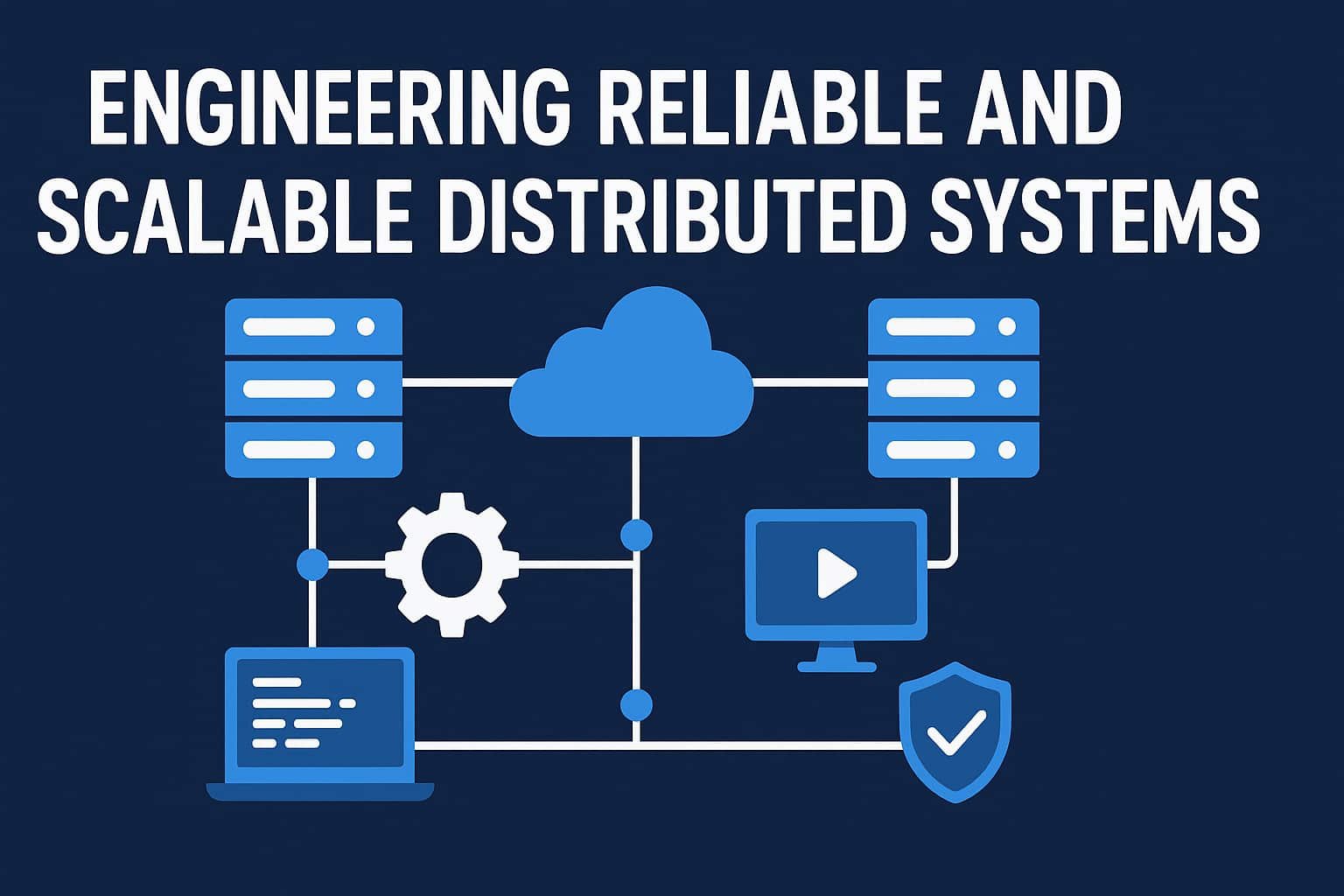
Distributed systems have become the backbone of today’s digital infrastructure. From global e-commerce platforms and real-time analytics engines to large-scale databases and cloud computing services, distributed architectures power nearly every major application. The concept of distributing computation and data across multiple nodes offers tremendous advantages — scalability, fault tolerance, and efficiency — but also introduces complexity that demands rigorous engineering discipline.
Distributed Systems Engineering focuses on the design, implementation, and maintenance of systems that operate across multiple machines, often spanning different geographical regions. It is a field where computer science meets systems thinking, requiring a deep understanding of networking, concurrency, fault tolerance, and synchronization. The goal is to ensure that, despite distributed components and potential failures, the system behaves as a single cohesive unit.
Foundations of Distributed Systems
At its core, a distributed system is a collection of independent computers that appear to users as a single system. Each node in the system performs part of the computation, and they communicate via message passing over a network. Unlike centralized systems, distributed systems face unique challenges related to communication delays, partial failures, and consistency of shared state.
The famous CAP Theorem, formulated by Eric Brewer, articulates a central trade-off: a distributed system can only guarantee two out of three properties — Consistency, Availability, and Partition Tolerance — at any given time. This principle forms the basis of architectural decision-making for engineers designing such systems.
To manage these constraints, engineers often rely on replication, consensus algorithms, and eventual consistency mechanisms. Systems like Apache Cassandra, Google Spanner, and Kafka embody these principles, balancing trade-offs depending on their use cases.
Consistency ensures that all nodes see the same data at the same time, Availability guarantees that every request receives a response, and Partition Tolerance allows the system to continue functioning even when communication between nodes is unreliable. Striking the right balance among these factors defines the success of a distributed architecture.
As the computer scientist Leslie Lamport once noted, “A distributed system is one in which the failure of a computer you didn’t even know existed can render your own computer unusable.” His observation encapsulates both the power and fragility of distributed design — where interdependence is both a strength and a vulnerability.
Engineering Principles and System Design
Designing a distributed system begins with defining clear goals: scalability, reliability, performance, and maintainability. Achieving these goals requires adherence to fundamental engineering principles and a deep understanding of trade-offs.
1. Modularity and Service Decomposition
Breaking large applications into smaller, autonomous services is crucial for maintainability and fault isolation. This is the principle behind microservices architecture. Each service is responsible for a specific domain, communicates through well-defined interfaces (often via REST or gRPC), and can scale independently.
2. Data Replication and Consistency Models
Replication ensures that data remains available even when some nodes fail. However, maintaining consistency across replicas is challenging. Systems adopt different consistency models — from strong consistency (used in systems like Spanner) to eventual consistency (used in DynamoDB or Cassandra) — based on their tolerance for latency and data staleness.
3. Consensus and Coordination
Consensus algorithms like Paxos, Raft, and Zab ensure agreement among distributed nodes even in the presence of failures. These algorithms are the foundation for distributed databases, configuration stores, and coordination services like ZooKeeper or etcd. Implementing consensus correctly is complex, as it must handle network partitions, leader elections, and retries gracefully.
4. Fault Tolerance and Recovery
Failures in distributed systems are not exceptions — they are expected. Engineering for fault tolerance involves designing systems that can recover automatically through redundancy, replication, and retry mechanisms. Techniques such as checkpointing, state replication, and transactional logs ensure that the system can resume operations without data loss.
5. Scalability and Load Balancing
Scalability ensures that system performance grows linearly with added resources. Load balancers distribute incoming requests evenly across nodes, preventing bottlenecks. Horizontal scaling — adding more machines instead of increasing the capacity of a single one — allows systems to handle massive traffic efficiently.
Through these principles, engineers build distributed systems that can sustain billions of transactions daily, deliver global availability, and recover gracefully from inevitable disruptions.
Challenges in Distributed Systems Engineering
While distributed systems offer immense benefits, their complexity presents numerous engineering challenges that must be handled carefully.
1. Network Reliability and Latency
Network communication is inherently unreliable. Packets can be lost, delayed, or duplicated, and latency can vary significantly between nodes. Engineers must design systems that tolerate these inconsistencies through retry mechanisms, idempotent operations, and timeout management.
2. Concurrency and Synchronization
Managing concurrent processes across multiple machines requires precise synchronization. Distributed locks, vector clocks, and versioning systems help maintain order and causality among events. However, overusing synchronization can lead to bottlenecks, so engineers must strike a balance between consistency and throughput.
3. Data Consistency and Conflict Resolution
When data is replicated across nodes, updates can occur simultaneously, leading to conflicts. Conflict-free replicated data types (CRDTs) and operational transformation algorithms provide mechanisms for automatic resolution, ensuring data integrity without sacrificing availability.
4. Monitoring and Observability
With thousands of nodes operating in parallel, detecting failures becomes a challenge. Distributed tracing, centralized logging, and metrics aggregation (via tools like Prometheus or OpenTelemetry) enable engineers to visualize system health and performance. Observability transforms the black box of a distributed system into a transparent, debuggable entity.
5. Security and Access Control
Securing distributed systems is more complex than securing monolithic applications. Engineers must authenticate and authorize every inter-service request, encrypt data both in transit and at rest, and protect against distributed denial-of-service (DDoS) attacks. Implementing zero-trust principles and secure communication protocols is essential for maintaining integrity and confidentiality.
Each of these challenges underscores why distributed systems engineering is considered one of the most intellectually demanding areas of software development — requiring expertise not just in coding, but in systems thinking, mathematics, and human-centered design.
Real-World Applications and Case Studies
Distributed systems are ubiquitous, silently supporting nearly every digital experience we rely on.
1. Cloud Infrastructure
Public cloud providers like Amazon Web Services, Google Cloud, and Microsoft Azure rely on massive distributed infrastructures. Services such as Amazon S3 or Google Bigtable manage petabytes of data across data centers worldwide, using replication and partitioning to achieve near-perfect uptime.
2. Distributed Databases
Databases such as Cassandra, MongoDB, and CockroachDB are designed to operate across clusters. They ensure data availability even if individual nodes fail, offering developers flexible consistency models suited to different workloads.
3. Content Delivery Networks (CDNs)
Companies like Cloudflare and Akamai operate global CDNs that distribute content geographically to minimize latency. They use sophisticated caching algorithms and load distribution to deliver web assets quickly and reliably to users across the globe.
4. Financial Systems
Banks and fintech companies depend on distributed transaction systems to process millions of payments daily. Systems like Apache Kafka provide reliable message streaming, ensuring transactions are processed sequentially and without loss.
These examples demonstrate that distributed systems engineering is not an abstract academic pursuit — it’s a practical discipline driving some of the world’s most critical technology infrastructure.
Conclusion
Distributed Systems Engineering represents the convergence of computing theory and practical problem-solving. It is a discipline that demands precision, creativity, and a deep respect for complexity. Engineers working in this field must embrace uncertainty, anticipate failure, and design for resilience.
By adhering to principles such as modularity, fault tolerance, and strong observability, organizations can build systems that deliver reliability at scale. The work is challenging, but the payoff is immense — systems that empower billions of users, run continuously across continents, and adapt seamlessly to changing demands.
Distributed systems may be invisible to most users, but they form the unseen architecture of the modern digital world. And for engineers, mastering their design is both an art and a science — one that defines the reliability of technology itself.