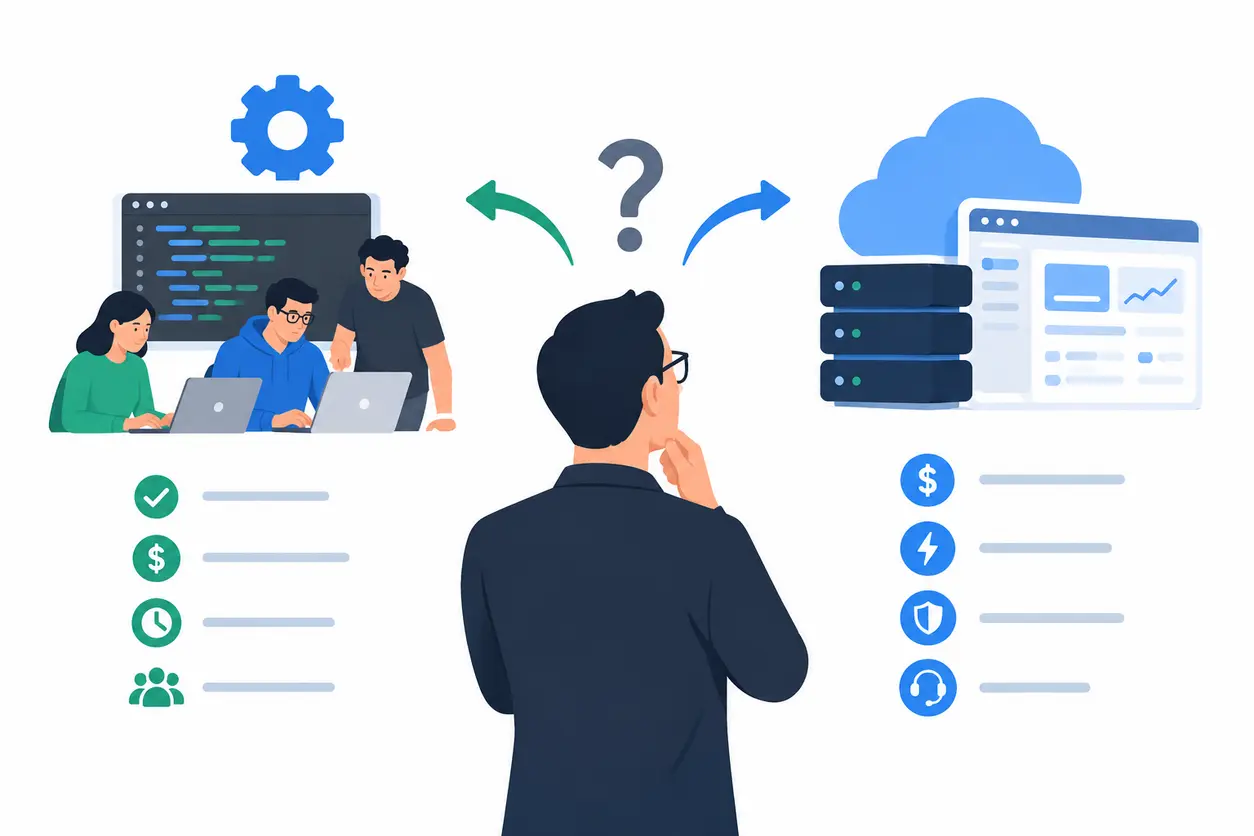
A small budget does not justify a homemade deployment platform. It just makes the cost of owning one harder to absorb. For a CTO with a small team, I would buy managed delivery infrastructure, keep release policy in the repository, and pay for a tested way out. “Doing it properly” means retaining control over what can ship, not operating every component that ships it.
Buying the delivery plumbing is cheaper than owning its failure modes
The build-versus-buy question is often framed around the first successful deployment. That is the cheapest part of the system. The more consequential question is who repairs a runner that cannot reach the registry, renews a broken credential, or restores deployment history when a service is unavailable. A small team can write the initial workflow quickly; it cannot make those responsibilities disappear by leaving them out of the estimate.
I treat Build a CI CD pipeline in 2 days then decide buy vs build as a useful time-box, not a procurement test, because a pipeline that works for two days has not yet demonstrated how it behaves during credential rotation or provider failure. Use that exercise to identify the release steps your team needs to control. Do not use it to conclude that the team should operate the runners, artifact store, and deployment controller.
Here is an illustrative budget model, not a vendor quote: if maintaining an in-house delivery stack takes 8 engineering hours per week at a burdened rate of $100 per hour, labor alone costs $3,200 over a four-week period. A managed option budgeted at $500 for that same period could still be the cheaper choice even after adding usage charges. Your numbers will differ; the decision changes when measured maintenance time is low enough, or managed usage high enough, to reverse that gap. Put both figures on the same calendar and include the person who answers failed releases.
For a team already using GitHub, my default purchase would be GitHub Actions hosted runners with OpenID Connect (OIDC) federation into AWS IAM, images stored in Amazon ECR, and deployments to Amazon ECS on Fargate. GitHub Actions workflow permissions should grant id-token: write only to the job that needs an AWS role; that constraint limits which jobs can request deployment credentials. The IAM trust policy should restrict the repository and environment claims, because accepting any workflow in the organization would make the federation too broad. The team still owns its application, workflow files, IAM policy, and recovery procedure. It does not own runner scheduling or host patching.
I would not install self-hosted GitLab, a runner fleet, and an artifact registry merely to avoid a recurring subscription, because those components turn a purchasing decision into a standing maintenance commitment. Self-hosting can be justified by a constraint a managed service cannot meet, but “we can get the software running” is not evidence that the constraint exists.
A small release contract is worth funding even when the platform is rented
Buying execution capacity does not mean buying release judgment. The company needs a short, enforceable contract for every production change: which commit produced the image, which checks passed, who approved the release, which identity deployed it, and how the team will return to a known-good version. Those are business decisions expressed as technical controls. They should remain readable in the repository rather than living only in a vendor dashboard.
Start with a container image tagged by the full Git commit SHA and recorded by immutable image digest. Have GitHub Actions build it, run the relevant tests, and publish it to ECR once. Promote that same digest to production rather than rebuilding from the branch name, because a second build may resolve different dependencies or base-image contents. Syft can generate a software bill of materials in SPDX format; Cosign can sign the image digest. Neither proves that the application is safe, but both give an investigator a concrete artifact to match to a deployment.
Keep the production gate modest and specific. As an initial value to tune, require one approval outside the author’s account before a production deployment; a second approval is worth its delay only if it addresses a defined risk. Set GitHub Actions concurrency for the production environment so that two workflows cannot independently promote competing images. Use Terraform to review changes to the ECS service, IAM roles, and load balancer alongside the application change when those resources are affected. Store runtime secrets in AWS Secrets Manager rather than in workflow files, because a workflow should receive a short-lived deployment identity, not become a second secret database.
The following Bash gate runs after an ECS deployment. It requires AWS CLI credentials and three environment variables, waits for the service to stabilize, then rejects a service with no desired tasks or a mismatch between desired and running tasks:
#!/usr/bin/env bash
set -euo pipefail
: "${AWS_REGION:?}"
: "${ECS_CLUSTER:?}"
: "${ECS_SERVICE:?}"
aws ecs wait services-stable --region "$AWS_REGION" \
  --cluster "$ECS_CLUSTER" --services "$ECS_SERVICE"
read -r desired running < <(aws ecs describe-services \
  --region "$AWS_REGION" --cluster "$ECS_CLUSTER" \
  --services "$ECS_SERVICE" --query \
  'services[0].[desiredCount,runningCount]' --output text)
test "$desired" -gt 0 && test "$desired" -eq "$running"
That check catches an incomplete ECS rollout; it does not establish that customers can use the service. Add a request through the Application Load Balancer and a post-release check against an application metric, such as HTTP 5xx rate, because healthy tasks can still serve broken responses. OpenTelemetry instrumentation can provide a stable request metric across runtime changes. A candidate threshold of 1% 5xx responses over 10 minutes is a value to calibrate against normal traffic, not a universal safety standard. If traffic is too sparse for that window to mean anything, use a synthetic request with a known expected result instead.
The cheaper runtime is the one the team can govern
A CTO can buy managed delivery and still choose poorly between a managed container service and a serverless function platform. I would not use Kubernetes vs Serverless Under Production Pressure as the purchasing rubric, because the immediate budget question is which operational responsibilities the team can credibly retain. Runtime features matter, but their cost includes the expertise needed to change and verify a release.
Option A: ECS on Fargate. It wins when the application already runs as a container, has a long-lived HTTP process, or needs predictable deployment behavior without operating Kubernetes nodes. It costs for allocated compute while tasks run, plus supporting services such as an Application Load Balancer, logs, and image storage. The team still needs to set task CPU and memory, health checks, autoscaling limits, and a deployment rollback condition. Those settings are manageable for a small team because they describe its service rather than a general-purpose cluster.
Option B: AWS Lambda with API Gateway. It wins when requests are short-lived and intermittent and the application fits the function execution model, because idle periods need not carry the same continuously running task allocation. It costs per invocation and execution duration, alongside API Gateway and observability charges; bursts can also create a bill or downstream load the team did not budget for. A team choosing Lambda must test timeouts, concurrency limits, and database connection behavior rather than treating “serverless” as an exemption from capacity planning.
These are alternatives for a particular workload, not a claim that one always has the lower invoice. For an existing containerized API with steady traffic, I would start with ECS on Fargate because it avoids rewriting deployment and process assumptions solely to change the billing model. For an infrequently invoked endpoint that already has a narrow request boundary, I would price Lambda first because keeping a task running may buy little. Require a monthly cost projection at expected traffic and at a plausible peak for both options; a single low-traffic estimate conceals the point at which the choice becomes expensive.
Kubernetes becomes a credible third choice when the organization has a concrete need for its scheduling or extension model and people assigned to govern it. I would not create an Amazon EKS cluster as a default “proper” version of a small-budget deployment, because managed control-plane hosting does not remove responsibility for cluster upgrades, workload policy, networking, and deployment conventions. Buy that flexibility when it solves a named constraint, not as a sign of architectural maturity.
An exit test is a better procurement safeguard than avoiding vendors
The strongest argument for building in-house is control. The weakest version of that argument assumes that using a vendor automatically gives control away. Control is more practical when the team can identify its production image, reconstruct the infrastructure, read its telemetry, and deploy through a documented alternative. A provider-independent diagram is less useful than evidence that those tasks can actually be done.
Before signing a longer contract, test the boundaries you would need to cross. Export a representative set of logs and traces using OpenTelemetry conventions, because proprietary dashboards are difficult to replace if the underlying signal cannot leave them. Confirm that image digests can be pulled from the registry with a documented identity, and retain the Dockerfile and build inputs in source control. Review whether Terraform state can be recovered and whether the IAM roles it creates are understandable without access to a departing employee’s account. None of this requires running two production platforms; it requires knowing what the current platform holds.
Set a procurement threshold in terms of work, not slogans. For example, give two engineers one working day to deploy the same image to a fresh non-production environment using the documented configuration. That is a proposed acceptance test, not a promise that every application can be migrated in a day. Record the blockers: a vendor-only secret, an undocumented manual approval, an image that cannot be retrieved, or a load-balancer setting nobody owns. Each blocker gives the CTO a negotiable requirement or a small piece of engineering work with a clear payoff.
Price the exception path as well. Hosted runners may be unsuitable for a build that needs access to a private network; in that case, a narrowly scoped self-hosted runner can be cheaper than redesigning the network. That exception should have an owner, patch schedule, and retirement condition, because an untracked exception gradually becomes the platform the team thought it had avoided. Likewise, a managed service may impose usage limits or contract terms that cost more than operating an internal alternative at sustained volume. Revisit the decision using actual invoices and maintenance hours rather than defending the original choice.
Fund one reversible release before funding a platform
Ask an engineer to select the next low-risk production change and write down its image digest, deployer identity, approval, health check, and rollback command before it ships. Time the work and price the missing pieces. If the team cannot reproduce that release from its repository and documented credentials, fund the gap first. A platform purchase can then solve a demonstrated problem instead of becoming one.